The work, in the order the decisions came
- Was the lane open, or avoided on purpose. Known: the format worked on ranked players, with tour cooperation. Unknown: whether an incumbent had a structural reason to stay away from the developmental tour. The question I asked was not whether anyone had done it yet, but whether a show built with the tour's cooperation has a reason to stay close to ranked, sponsor-friendly players. It does. That put an unranked cast one step outside the incumbent's center of gravity, which is a lane, not just a gap. It produced the positioning, and it told me the label was shorthand, not a defense: anyone can borrow Last Chance U for golf in an afternoon.
- Proof before permission. Known: a platform-first path puts the timeline on a gatekeeper's calendar. Unknown: whether a cast and roster assembled without approval would be a stronger position than a polished deck. I decided it would, and the venture's first year went to signing, not selling.
- The partners, one gap each. Known: the venture needed producer credibility it did not have. The question was which reachable partner covered which gap, rather than pretending a competitive selection ran. Sugar23 for story and format credibility, Front Office Sports for sports-media distribution, Winterstone Pictures for production execution. Each covers a distinct function and none duplicates another. What stayed open, and has stayed open the whole time, is a name the room already trusts standing beside them.
- The cast, chosen for stakes. Known: the show needed golfers whose jeopardy was real. Unknown: whether ranked, already-sponsored players or unranked grinders made the better cast. I chose the grinders, because that is the story an incumbent's ranked-player format cannot tell without changing what it is. Jasper Sports Management contracted them, and its deck, attached whole as Attachment D, shows the process from discovery to the representation agreement. The count is on the cover.
- The agreements. Known: the venture's fastest-closing sponsor would be a brand already paying a golfer. Unknown, when the first agreements were drafted: whether such a sponsor could take the meeting, like the pitch, and still pay the golfer directly. The question was what the venture had to own for a sponsor path to exist at all. The answer is in the section above; outside counsel drafted it, and the structure was mine. Attachment C carries it as architecture.
- The early money. Known: the vans, the entry fees and the filming had to be funded before any platform paid. Our capital partner and I raised it early, in cash, merchandise and materials, through outreach to partners, funds and producers; the figure is on the cover. Merchandise and materials were as real as the cash. A van, a set of clubs and a hotel block are what a mini-tour golfer actually lacks.
- The cast as a channel. Known: some of the golfers already carried a personal sponsor. Unknown: whether that relationship could be sold against without an audience. The question was what a brand that already pays a golfer can buy before a single episode airs. The honest answer is narrower than a tier sheet suggests: a rights option at a pre-air rate, and access to production-stage content, behind-the-scenes footage and social cutdowns the golfer's own channels do not have. On-screen integration is priced and delivered once episodes exist. Naming that precisely is what made the golfer-level tier closeable before air.
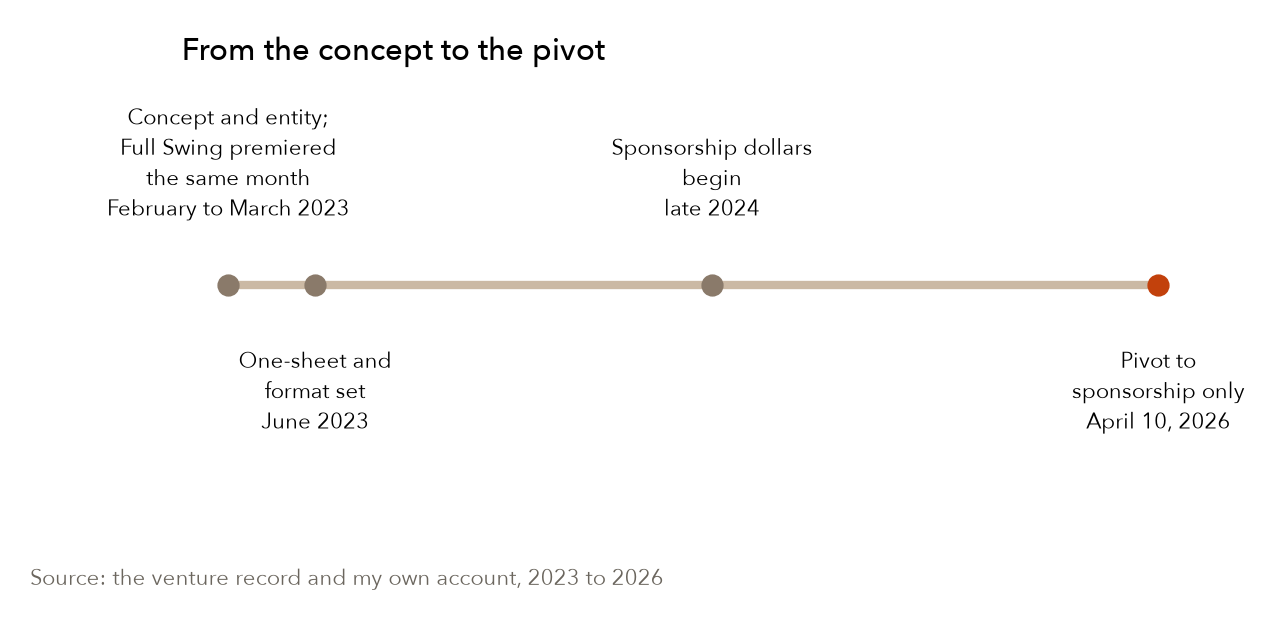
- The pivot, and the machine behind it. Known: the platform path had capped what the show could earn on its own timeline. Unknown: whether a sponsorship-only model would read as a retreat. It does not, if the message holds one distinction: the cast and the format are the constant, and the buyer of the pitch moved. On April 10, 2026 the venture retired its network, streamer and celebrity executive-producer outreach, put a daily sponsorship outreach cadence in place aimed at named brand-partnership and sports-marketing leads, never a general inbox, and installed the sponsorship pipeline, with a do-not-contact rule so our outreach never touches a brand Sugar23 or Front Office Sports is already pursuing, parent and subsidiary umbrellas included.
What it produced, and what is still open
The venture holds what it did not hold in February 2023. A signed cast, under agreements that keep the in-show rights with the show. Producers of standing, verbally attached and holding through the pivot. Footage of the actual chase, wins included. Sponsor money since late 2024, in the figure on the cover. And a pipeline that can be run and measured instead of a list of names.
| Layer | Who | What it covers |
|---|---|---|
| Creator | Jesse Fowler | Concept, structure, partners, business model |
| Brand | Common Ground | Brand architecture and the deck |
| Early capital | Our capital partner, with me | The early money, in cash, merchandise and materials |
| Executive producer | Sugar23 | Story and format credibility |
| Executive producer | Front Office Sports | Sports-media distribution and audience |
| Production | Winterstone Pictures | Day-to-day production |
| Cast | Developmental golfers, contracted through Jasper Sports Management | The story; the in-show rights held by the venture |
The sponsorship waterfall is deal architecture, not pricing. It runs from the tier that needs nothing but the cast to the tiers that need an audience.
| Tier | Inventory | Deliverable before air | Buyer |
|---|---|---|---|
| Title or presenting | Full-series integration, a presented-by credit | Nothing; requires an audience | One anchor brand per season |
| Executive producer co-credit | On-screen credit beside Sugar23 and Front Office Sports | Nothing separately priceable | A brand buying prestige association |
| Golfer-level tie-in | A rights option, production-stage access, on-screen integration once episodes exist | The option and the access, priced today | Equipment and apparel brands already paying a golfer |
| Episode or segment placement | A media buy inside finished episodes | Nothing; requires an audience | Performance-marketing buyers |
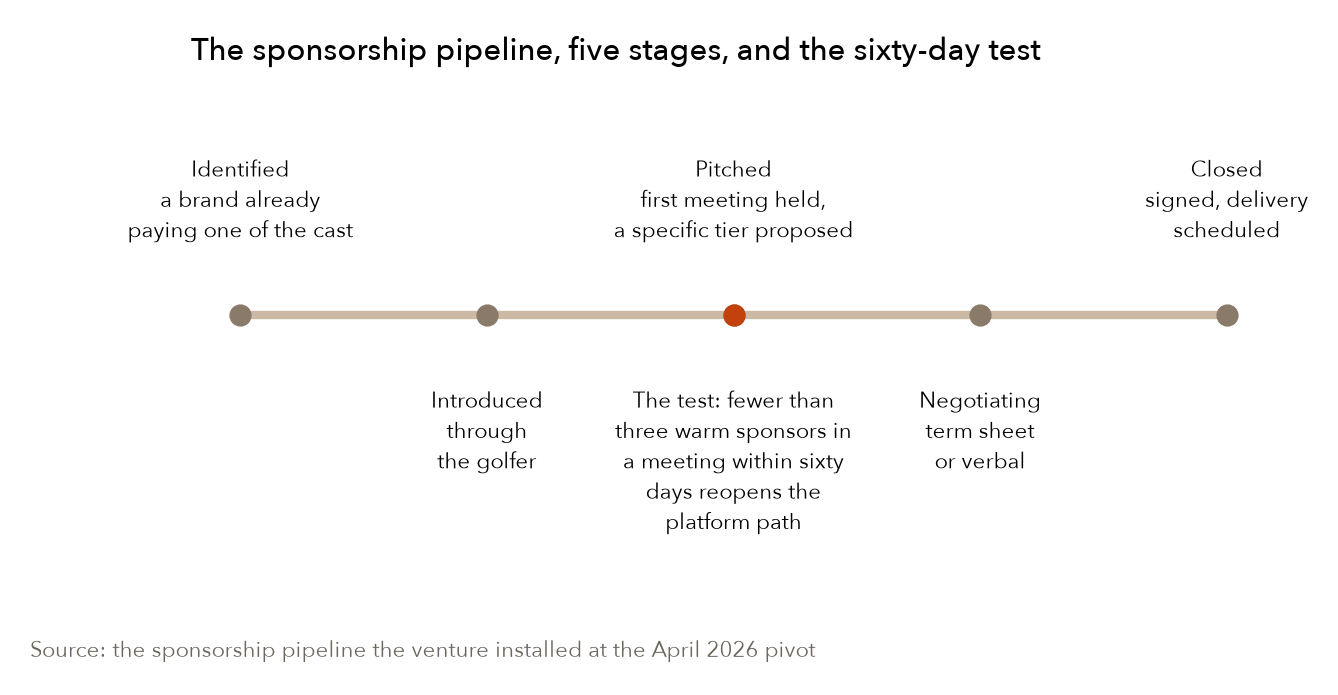
Only one tier can be delivered before air, which is why it is sequenced first, and the pipeline below is built to run it, identified through closed, with the meeting test that tells us early whether the cast's warm sponsors are reachable at the scale the pivot needs. If they are not, the platform path reopens as primary. That test is the number I would ask about first if I were reading this.
Status, without dressing it up: nothing is placed. The partners hold. The ideal is a miniseries into Full Swing, and we have spoken to its producer. What is open is the executive-producer name and the channel a sponsor is buying against.
Drive to Survive and Full Swing proved people will watch money and magic. Both were built on names. My bet was that a guy one bad week from losing his card works without the name.
What we kept, replaced and installed
Kept. The format and the cast, through the pivot and after. The partner roster. The label, as shorthand only. And a rule of my own: my name stays off the deck and the outreach, because a show with no credits needs the names that have them.
Replaced. The platform-first content-and-equity model. I put it in, in 2023, because it is how docuseries get made: a platform funds, a platform distributes, and the venture trades rights and equity for the commitment. What was faulty was not the model but what it did to the venture's timeline. The biggest possible outcome was the only path to revenue, and the calendar belonged to whoever we were pitching. It had to change when it did because the producers were in place, the cast was signed, and the only blocker left was brand capital; every month on the platform path was a month the sponsor path stood still.
Installed. The golfer agreements as structured. The sponsorship pipeline and its test. The do-not-contact coordination with the partners' own outreach. A daily outreach cadence aimed at named decision-makers. And a message architecture that keeps two pitches true at once: to a platform, we assembled what you would otherwise have had to approve and fund; to a sponsor, the show and the cast are in place, and what you buy is association on a timeline we control, not a platform's release calendar.
What it cost to hold the line, and what I watch
It has cost years without a closed platform deal, in a market that shifted under the venture while it waited. The dollars that came in were sponsor dollars, real and small next to what a distribution deal pays. The relationship effort went into meetings that opened and did not close, and the lesson from those meetings is the one in the title. Content proves the work is real. Credibility is a different currency, and it comes two ways: earned slowly through your own reachability, or borrowed quickly through someone else's name. Sugar23 is a borrowed name, and it opened rooms faster than footage ever did. It did not close them the way an earned relationship does, and that is why the executive-producer seat has stayed open with Sugar23 attached. I had seen the same shape years earlier in a different business, where the mechanics got us found and a reporter's phone call got us believed.
I would run the sequence again. Holding ownership through the unproven years, instead of trading it early for a distribution promise that never arrived, is what lets the venture take whichever deal finally lands, platform, licensing or sponsor, on its own terms.
What I watch. The meeting test in the pipeline above, because it is the first thing that can fail. Conversion at the pitched and negotiating stages, where the pre-air distribution objection surfaces. The channel a sponsor is buying against, which is the pitch's weakest sentence until a platform is named. Cast retention through the next qualifying cycle, since a funded competitor could sign a different roster inside one; the agreements make ours a position rather than a head start, but only while the cast stays. And the executive-producer name, which is what the venture has needed since the first meeting and what it still needs.
The result, in short
Eight golfers signed, under agreements that keep the in-show rights and the brand rights with the venture. Sugar23, Front Office Sports and Winterstone Pictures verbally on board as executive producers and production. About $200,000 raised early in cash, merchandise and materials, and a few hundred thousand in sponsorships since late 2024. Nothing is placed yet; the venture retired its platform-first outreach on April 10, 2026 and now runs a daily sponsorship pipeline aimed at named brand-partnership leads.
A slice of the project list
A few related projects.
- Contractor Gorilla: search strategy and an advisor seat with equity in the agency (2014 to 2017)
- Ink Games: Seed Advisor, Go-to-Market, and the seed raise through Prince Capital (2019 to 2020)
- Alice Mushrooms: Seed Advisor, Go-to-Market, retail entry into national grocery (2022 to 2026)
- Aycre Capital: fund formation and capital raise process, Managing Director (2022 to 2023)